How Much Retirement Are You Drinking Away? The Latte Factor and the Power of Compounding Small Change
There's a joke that's been around at least 30 years:
A doctor tells a lifelong smoker: "You've smoked a pack a day for 20 years. If you'd quit back then, you could have a Ferrari by now."
The smoker replies: "So where's your Ferrari?"
Doctor: "Downstairs. Why do you ask?"
The doctor probably wasn't just preaching about saving — he was hinting at the quiet, invisible power of compounding. So the lesson seems obvious: redirect all those small daily expenses into savings or investments instead.
But is that always the right call?
What Is the Latte Factor?
The Latte Factor is a personal finance principle coined by American bestselling author David Bach: small, habitual daily expenses that seem trivial — a daily coffee, a streaming subscription, a weekly lunch delivery — compound into surprisingly large amounts when measured against their investment opportunity cost over 10–40 years.
Those small daily expenses that seem trivial
multiplied by time and compound interest
grow into a number far larger than you'd ever expect
It's not an attack on coffee itself. The real point is opportunity cost: what would that money be worth today if you had invested it instead of spent it?
Running the Numbers: A 30-Year Journey for $5 a Day
Say you skip one $5 latte daily — roughly the price of a Starbucks drip coffee or basic espresso drink
That's about $150 saved each month
Invested in a global index ETF at a 7% annualized return — close to the S&P 500's long-run historical average
| Years | Total Contributions | With Compounding |
|---|---|---|
| 10 years | ~$18K | ~$26K |
| 20 years | ~$37K | ~$77K |
| 30 years | ~$55K | ~$178K |
| 40 years | ~$73K | ~$376K |
One cup of coffee's worth of savings each day
Becomes $178,000 after 30 years
And clears $376,000 after 40
What Does Your Daily Habit Actually Cost You?
Everyone has their own latte factor
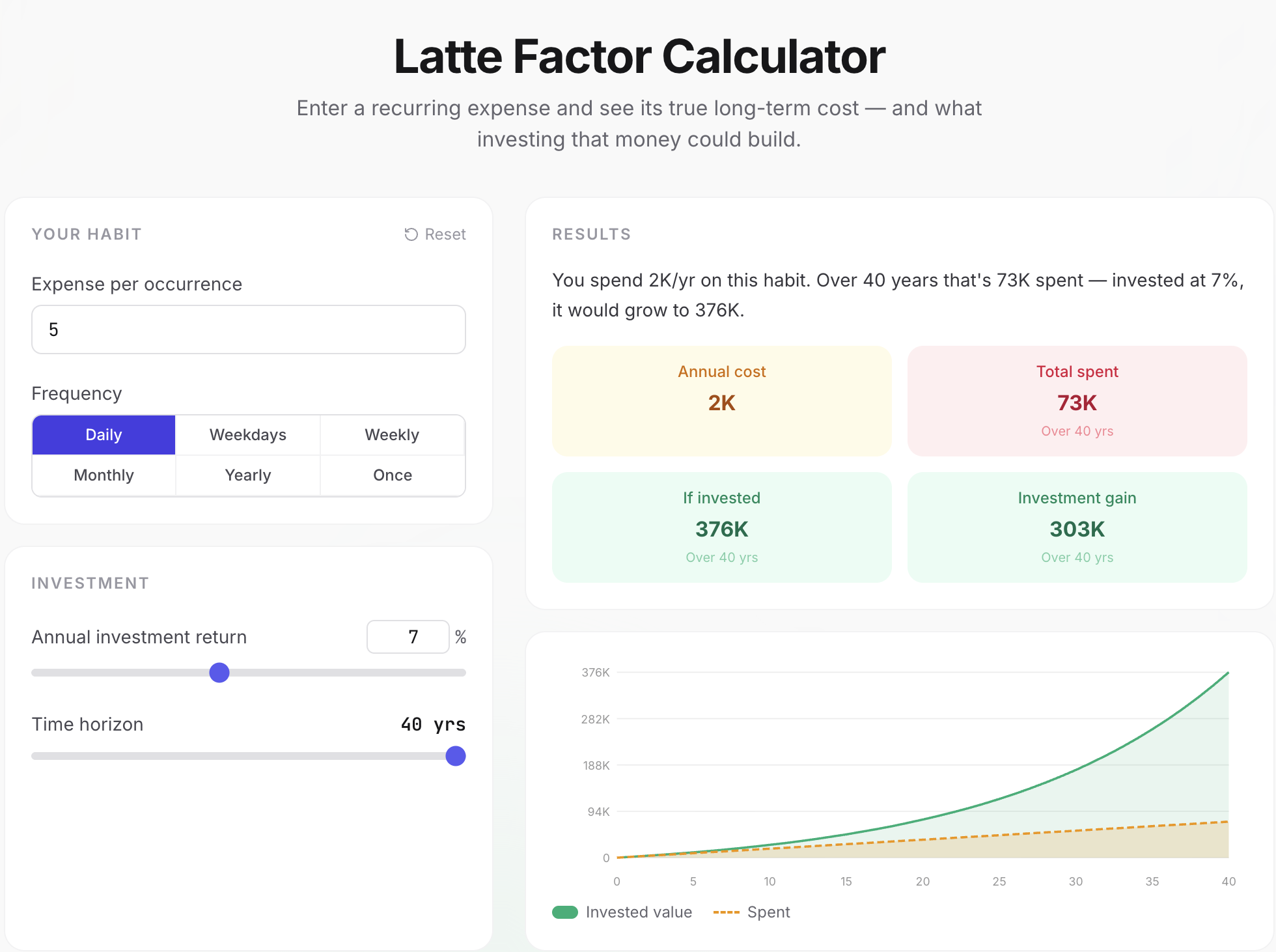
Click 👉 Latte Factor Calculator
Enter your daily habit and see whether it's worth a car
or a down payment on a house — 30 years from now
What's Your Latte Factor?
David Bach's point is that the latte factor is "those habitual, unconscious purchases you make every day or week"
So it doesn't have to be coffee:
- DoorDash / Uber Eats delivery fees + tips: $5–10 per order
- Netflix / Max / Disney+ / Apple TV+ / Spotify all together: $60–100/month
- App subscriptions on auto-renew you genuinely forgot about: $5–15/month each
- Extra drinks or appetizers at your weekly dinner out: $15–30
Add those up
Your "latte factor" is probably much bigger than you think
"Does This Mean I Have to Give Up Every Pleasure?"
Absolutely not.
The most common misreading of this concept is
"You should stop buying coffee, skip every treat, and save like a monk"
David Bach himself said:
It's not about telling you what you can't enjoy — it's about making conscious choices
If your daily coffee is the thing that gets you through a brutal commute
or a moment of quiet before the chaos starts
that's a necessity
But if it's just habit — mindless routine you've never questioned
That's when it's worth pausing to ask: is this money well spent?
Financial freedom isn't about deprivation
It's about making every dollar a deliberate decision
So What's Actually Worth Spending On?
There's no universal answer
Cutting out daily coffee might save less than skipping one vacation
But I love the framing from Die with Zero author Bill Perkins:
Money is a tool for buying back freedom and lived experience
So when you can, spend on experiences that generate memories
Because memories keep paying you back — a kind of "memory dividend"
Each time you revisit them, the joy is still there
Experiences also have a best-before date
Which is why it's worth collecting them while you're young
Travel is the obvious example
For everyday indulgences, I still buy coffee and go to nice restaurants
But I've become more intentional:
Less often, and always somewhere new — a different menu, a different neighborhood
Maximizing the experience, not just the habit
One Small Step to Start
If this article made you want to change something
You don't need to overhaul your whole budget at once
Just do one thing:
Write down every "unconscious expense" you make each day or week
Paper, phone notes, a napkin — anything
Don't change anything yet — just let yourself see it clearly
That moment of awareness
Is where financial freedom begins
This article is for educational purposes only and does not constitute investment advice. All calculations are hypothetical scenarios. Actual investment returns are subject to market fluctuations; past performance does not guarantee future results.
References
Frequently asked questions
What is the Latte Factor?
The Latte Factor is a personal finance principle coined by author David Bach: small, habitual daily expenses — like a daily coffee — compound into surprisingly large amounts when measured against their investment opportunity cost over 10–40 years. A $5/day habit at 7% annual return grows to $77K in 20 years and $376K in 40 years.
Is the Latte Factor about quitting coffee?
No. David Bach explicitly says it's not about telling you what you can't enjoy — it's about making conscious spending choices. If your coffee is meaningful to you, keep it. The Latte Factor is about identifying habitual, unconscious spending you've never questioned.
How do I calculate my Latte Factor?
Enter a recurring expense amount and frequency into the Latte Factor Calculator at appiclab.com/en/finance-kits/latte-factor. It computes the annual cost, total spent over your chosen horizon, and the future value of the equivalent investment at your chosen return rate.
What is compound interest?
Compound interest means earning returns on your returns. When you invest $150/month at 7% annual return, each year's gains are reinvested and themselves generate gains. This is why $150/month grows to $77,000 in 20 years — nearly double the $37,000 in raw contributions.

About the Author
indigo.la.ringo
A software engineer chasing the slash-career dream. Was trying to figure out my relationship with the world — now being forced to figure out my relationship with AI. Lately, obsessed with figuring out the relationship between people and money. Either way, whatever answer I land on, it's fine.
Feedback
Thoughts or suggestions after reading? I'd love to hear them.