Lump Sum or Dollar-Cost Averaging? Use the Risk Report to See Your Real Odds
While researching borrowing to invest
to convince myself to hold on with more conviction
I ran a lot of risk simulations
hoping to be ready to face the worst case
and ended up with a few new realizations instead
You've probably heard people tell you to buy half first
and to just hold once you've bought in
But is there any basis to these sayings?
Let's find out together
The investment risk report
I added a new feature to the 👉 loan-to-invest calculator:
you can simulate different market environments
but if you simply set the loan rate to 0
you can treat it as a lump sum you have on hand right now
about to enter the stock market
turning it into a plain comparison of lump sum vs. dollar-cost averaging
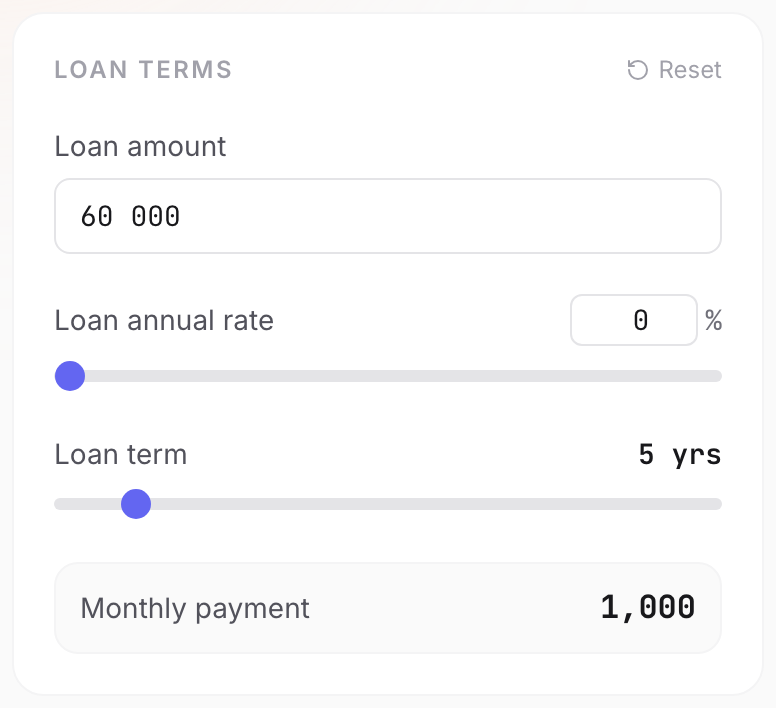
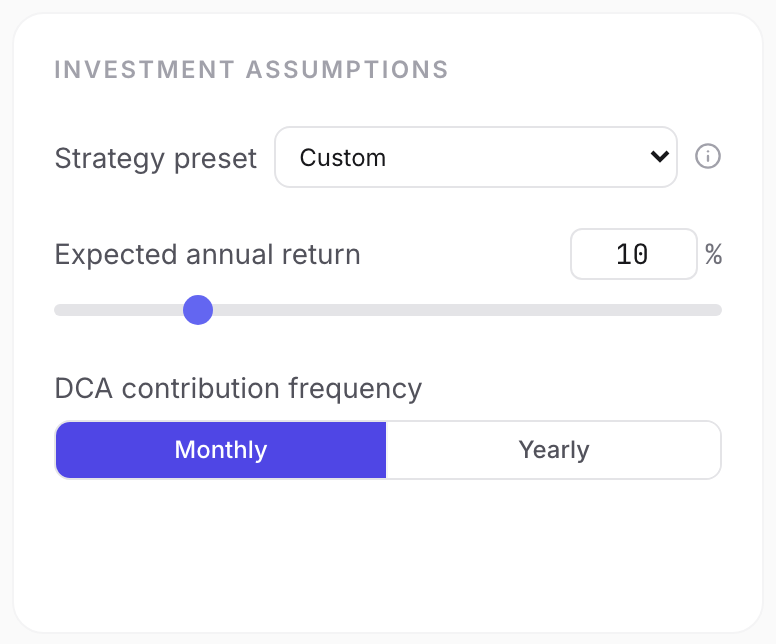
Assuming a total of $60,000 invested vs. $1,000 a month
with the loan rate set to 0 (swap in whatever number you like)
and a broad stock index over the past ~20 years (2006–2025) as the input
- CAGR (compound annual growth rate) 10% ( these recent years ran hot, so I dialed it down a bit )
- annualized volatility around 21%
- worst single-year drop 43% (financial crisis)
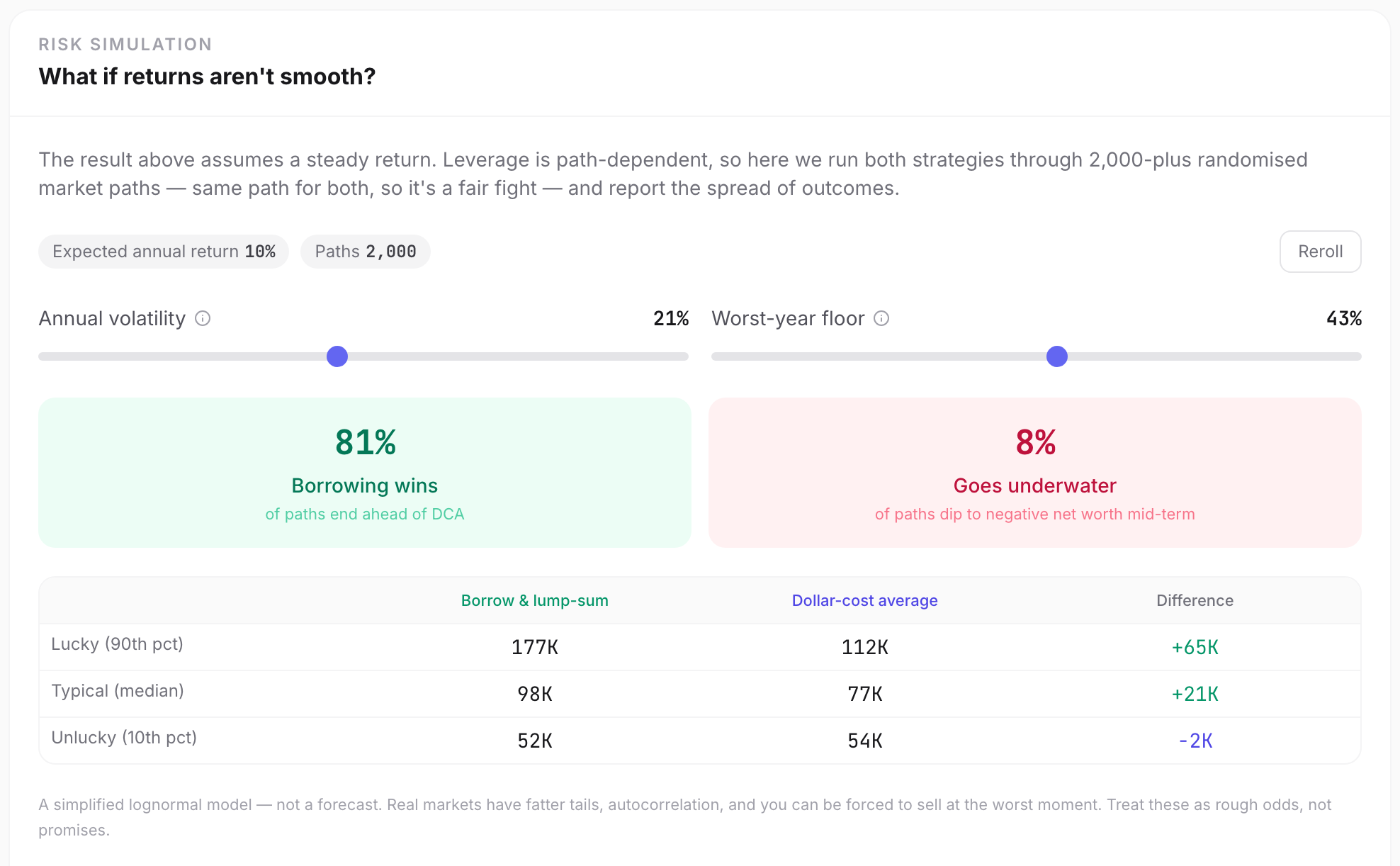
Through the Monte Carlo simulation below you'll find that
over a 5-year horizon
the lump sum wins about 80% of the time (this is at zero borrowing cost; interest would lower it)
even knowing the odds are this good
why can't we bring ourselves to buy?
The path we never see
After all, humans are emotional creatures
Scholars have proposed various theories to explain this
prospect theory, for instance, says we may overweight the odds of extreme events
and loss aversion adds its own braking effect
so that even with cash in hand
we don't dare go all in
Even when we rationally know the odds are better
we can't see all fourteen million possible futures the way Doctor Strange could
So what can we do?
Run the worst-case script first
If you read my previous post on borrowing to invest you'll remember
the thing a lump sum fears most is a crash in the very first year
which is exactly why I added the simulation report feature
click "generate report" below to analyze your outcomes across different scenarios

We'll again assume a total of $60,000 invested
- lump sum vs. $1,000 a month (1,000 × 12 × 5)
- loan rate set to 0
- CAGR (compound annual growth rate) 10%
- annualized volatility around 21%
- worst single-year drop 43% (financial crisis)
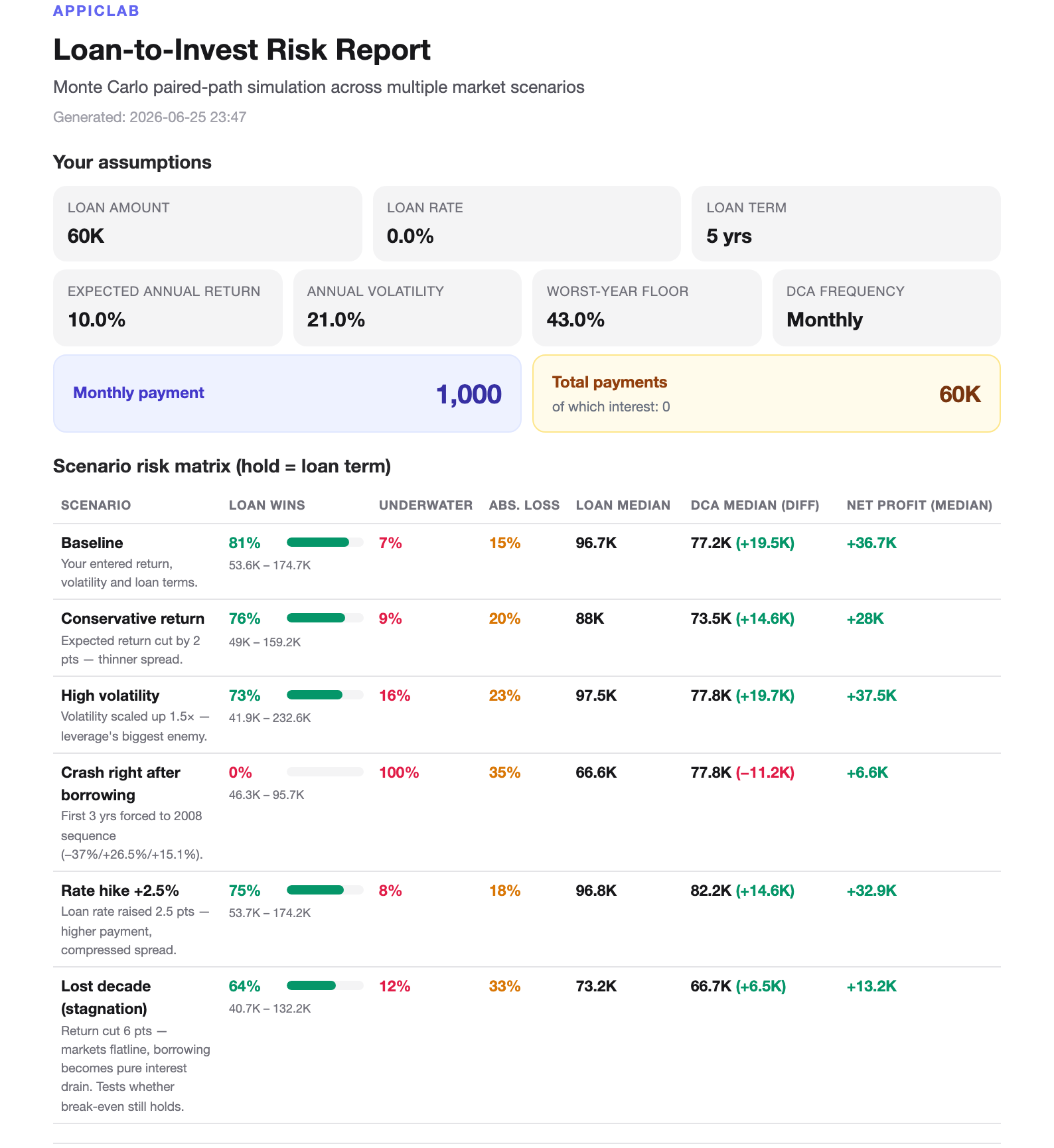
The report shows that
the lump sum wins basically everywhere else
except when a crash hits in the first year
which is exactly sequence-of-returns risk
Is there any way to avoid this risk?
Plenty of seasoned investors say: if you're scared, buy half first
and while building this simulation I stumbled onto something
buying half may not be an old wives' tale after all
but a kind of hard-won rule of thumb
On the risk-assessment page I lay out several different strategies

basically comparing buying half, splitting into three, and so on
and you can see that buying half dramatically lifts the win rate when a crash hits in year one
while the performance barely differs
Put plainly, this is a form of timing the market
We can't predict when a crash will come
nor how long a bear market will last
but if you use half of one year's gains as insurance
so you can buy in with peace of mind
why not?
After all, markets are mostly long bulls and short bears
and only by surviving pullback after pullback
do you reach financial freedom
The long game is the real finisher
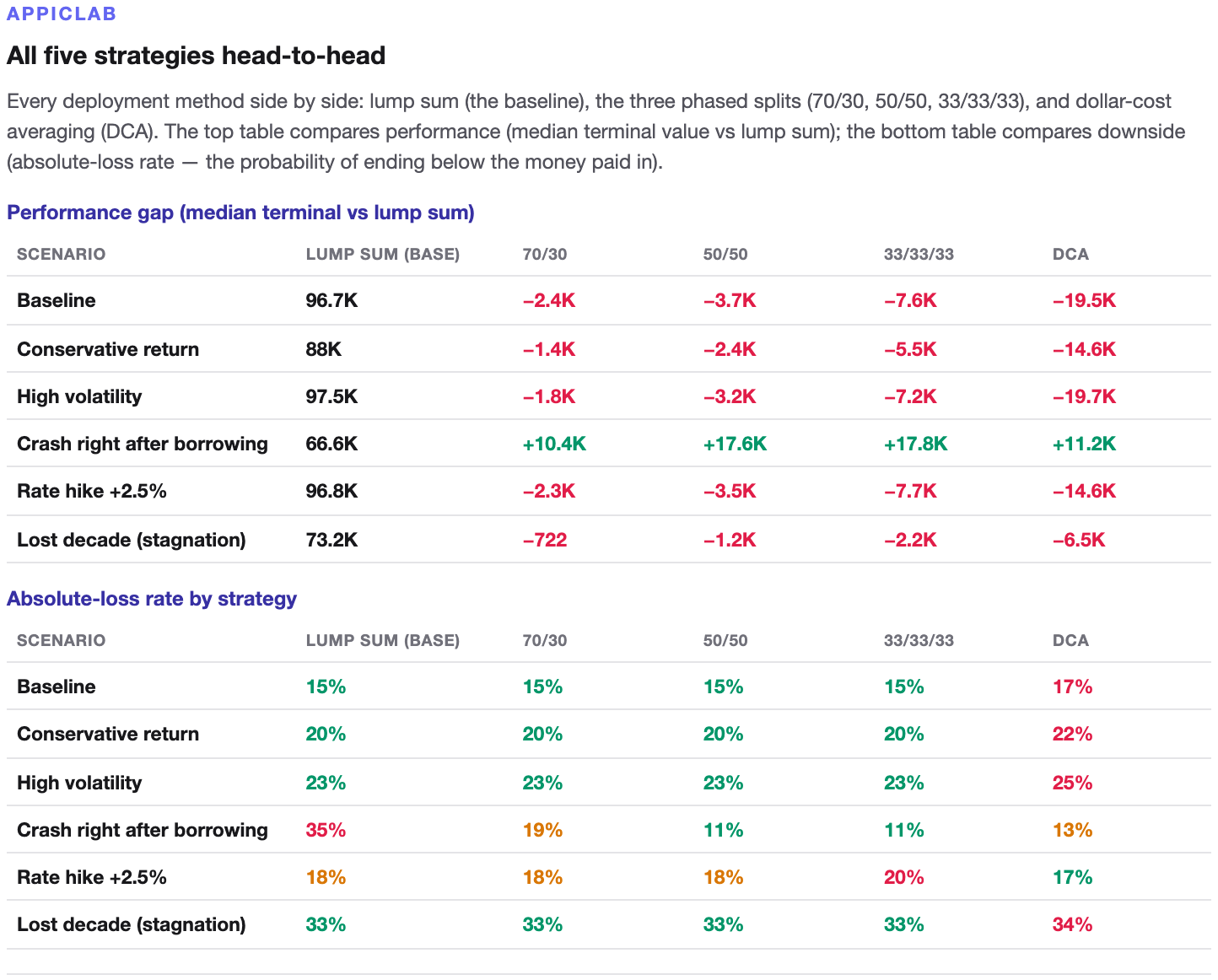
You've probably noticed that over the 5-year simulation
there's roughly a 20–30% chance
of ending up in the red
So is there another move?
Let's look at the next page
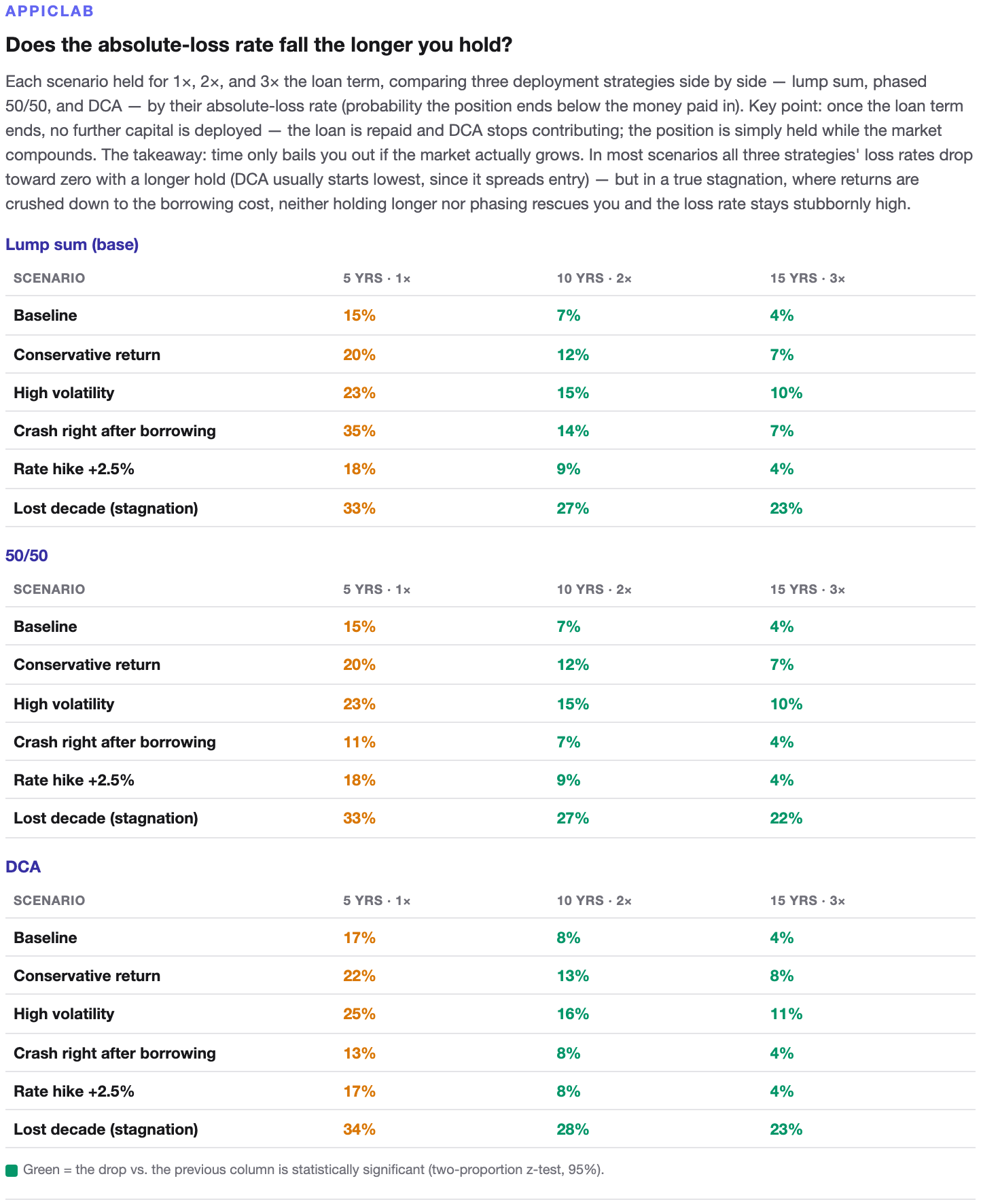
You'll find that if we stretch the timeline
the loss rate falls
out to 15 years
it drops into the single digits
and even in the most hopeless stagnation scenario
the loss rate keeps falling
Maybe time really is the one and only answer
and it makes me believe more and more
that getting rich is genuinely simple
but you need patience
a great, great deal of patience
Closing thoughts
This piece is something I'm leaving for my future self
so that if the day comes when a Financial Crisis 2.0 really does hit
I'll remember Water Breathing, Eleventh Form
— Dead Calm —
This tool and article are for educational reference only. Monte Carlo simulation estimates probabilities by random sampling — it is not a prediction of the future. Borrowing to invest is leverage, which magnifies both gains and losses; consult a qualified financial advisor and act within your means.
Further reading
Frequently asked questions
Lump sum (LSI) vs. dollar-cost averaging (DCA) — which is actually better?
Both strategies put the exact same cash out of your pocket each month; the only difference is whether the money enters the market early. Over the long run, as long as your investment return stays comfortably above your borrowing cost, the lump sum has the higher expected value — at 10% return, 21% volatility, over a 5-year horizon, the lump sum wins in roughly 80%+ of paths. But "wins on average" isn't "wins every time," and the biggest variable is sequence-of-returns risk.
What is sequence-of-returns risk, and why is it so dangerous when you've borrowed?
It means the order in which returns arrive heavily shapes the outcome, even when the long-run average is identical. Borrowed money is fully invested on day one, so a big drop in the first year or two hits your largest principal immediately — far worse than the same crash ten years later. That's why the report includes a "crash in the first year" scenario that drops a financial-crisis-sized fall right onto your entry year as a stress test.
People say "if you're scared, buy half first" — does that actually work?
While running the simulations I stumbled on the fact that this old rule of thumb may really have legs. The report compares full lump sum, buying half, and splitting into thirds: in the scenario where a crash hits in year one, buying half dramatically lifts the win rate, while long-run performance barely suffers. It's essentially using half a year's gains as insurance — you can't predict when a crash will come, but that insurance lets you actually pull the trigger.
Can I still lose money over five years? Does holding longer help?
Yes. Over a 5-year horizon, there's roughly a 20–30% chance of ending up in the red. But stretching the holding period clearly lowers the loss rate — out to 15 years it drops into the single digits, and even the most stubborn stagnation scenario keeps falling. Time, more than anything, is the real answer to borrowing to invest — provided you're very, very patient.
What does the 'risk report' actually compute?
It's an advanced feature inside the loan-to-invest calculator: a Monte Carlo simulation that, across multiple market stress scenarios, runs 100,000 random return paths each, then tells you the lump-sum vs. DCA win rate, the probability of going "underwater" (assets below debt), how different phased-entry strategies compare, and how the loss rate converges as you stretch the holding period to 2× and 3× the loan term. It won't promise you'll profit — it gives you a probability, which is the right language for facing the unknown.
I'm not borrowing — I just have a lump sum on hand. Is this report still useful?
Yes. Set the loan rate to 0 and the report collapses into the purest question of all: should a lump sum go in all at once, or be spread out? Whether it's a year-end bonus, proceeds from selling a house, or an inheritance, you still face lump sum vs. DCA and sequence-of-returns risk — and the report's conclusions apply just the same.

About the Author
indigo.la.ringo
A software engineer chasing the slash-career dream. Was trying to figure out my relationship with the world — now being forced to figure out my relationship with AI. Lately, obsessed with figuring out the relationship between people and money. Either way, whatever answer I land on, it's fine.
Feedback
Thoughts or suggestions after reading? I'd love to hear them.