Borrowing to Invest: Reckless Gamble or Rational Choice?
I've been seeing the news lately
We've apparently entered an era of second, third, even fourth loans all under one roof
Plenty of people take out personal loans to play the property and stock markets
and get slapped with all sorts of high-risk labels
So is this the legend of the teenage stock god
or the product of a rational choice?
"Fear comes from the unknown"
Rather than blindly following the crowd, it's better to do your own research
This article is part of what I've learned from my own digging
and along the way I built a little tool to compare this whole "loan-funded stock investing" idea
I trust you'll agree that in this day and age, investing is no longer an elective
so let's get to know what borrowing really means, together
What is borrowing to invest, really?
At its core, borrowing to invest (which is really a form of leverage) comes down to a single sentence:
You expect your "investment return" to be higher than your "borrowing cost (interest)" over the long run
In other words, it's the spread between your investment return and your loan interest.
As long as that spread is positive
you can use cheap interest
to buy the "time" of someone else's money
and put that capital to work for you sooner
This is also part of how many financial institutions make money:
they obtain funds at a lower cost of capital
then deploy them into higher-returning assets to earn the spread.
The problem is
in real life no one can guarantee
that this spread will always exist
So why do people still flock to it?
And what kind of risks are hidden behind it?
We'll savor them one by one in a moment
But before that
we need to be clear about what we're comparing against
The control group: comparing against "dollar-cost averaging"
After all, the whole premise of borrowing to invest is that you assume some asset's
positive returns will outweigh the interest
So what we should really compare is:
investing the same amount each month
but without borrowing
putting that money into the same asset via dollar-cost averaging
That is, Lump Sum Investment (LSI)
vs.
Dollar-Cost Averaging (DCA)
This is exactly what the little tool 👉 Loan-to-Invest Calculator is designed for:
- Loan-funded lump sum: borrow a chunk of money, invest it all into the index immediately, then repay principal + interest each month
- Dollar-cost averaging: don't borrow; take the same amount as the monthly repayment and invest it into the same index, bit by bit
Both strategies put out exactly the same cash each month
The only difference is that the loan-funded lump sum lets the capital "participate in the market earlier"
and the price for that is the interest
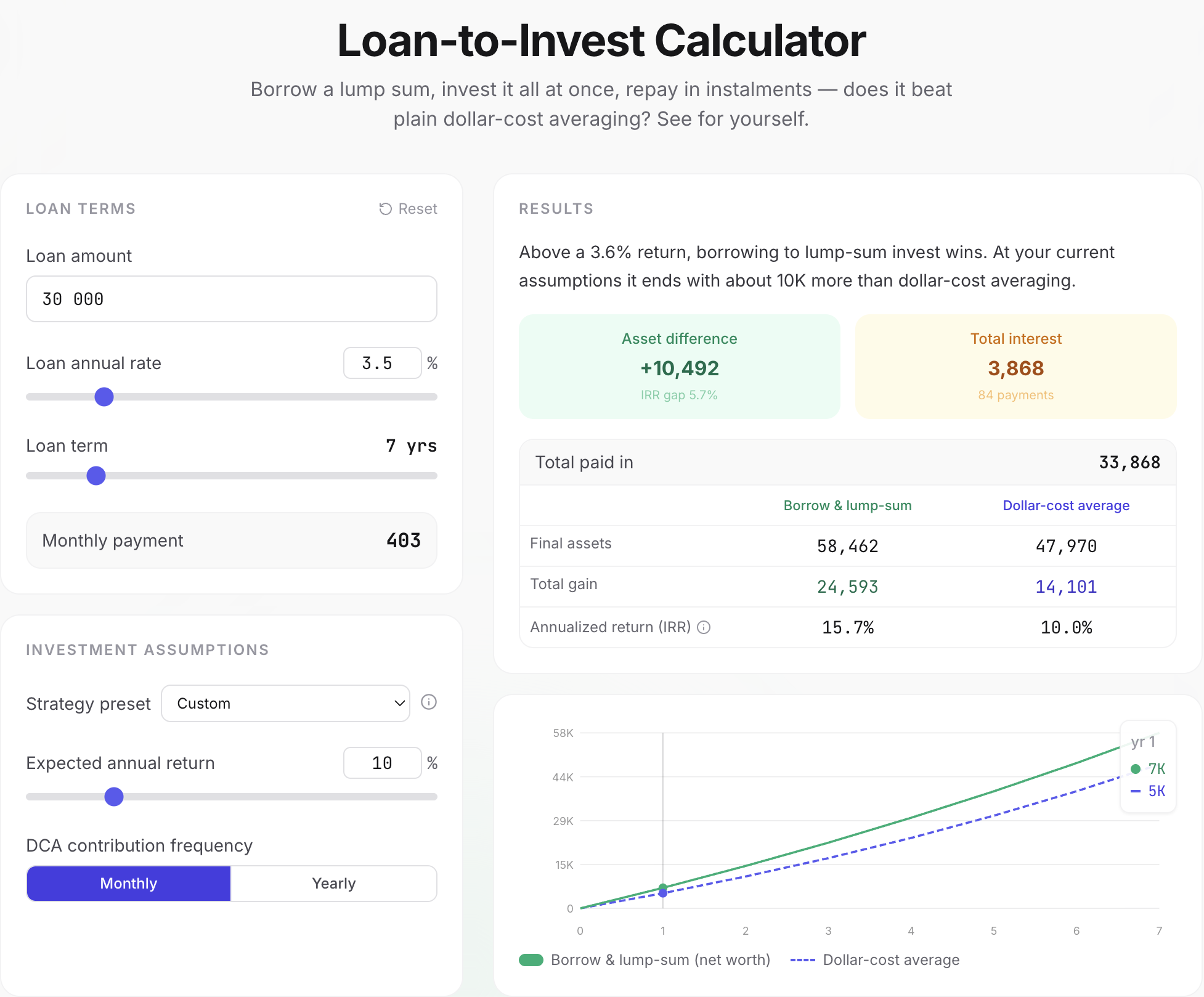
Let's actually run the numbers: a 5-year, $30,000 personal loan
Say you have a $30,000 personal loan
at 3.5% interest over 5 years
which works out to a monthly repayment of about $546
For the investment, let's pick SPY (1996–2025, with an annualized return of roughly 10.2%–10.8% over the past 30 years)
Scenario A (loan-funded lump sum): borrow $30,000 and invest it immediately into SPY at a 10% annual return, then repay $546 each month
Scenario B (dollar-cost averaging): don't borrow; invest $546 into the same ETF each month via DCA
| Item | Loan-funded lump sum (LSI) | Dollar-cost averaging (DCA) |
|---|---|---|
| Total assets at maturity | ~$48,315 | ~$41,783 |
| Total interest paid | ~$2,745 | ~$0 |
| Net investment return | ~$15,570 | ~$9,038 |
- Monthly cash out of pocket: ~$546
- Total invested over 5 years: ~$32,745
- Asset difference: the loan-funded lump sum beats dollar-cost averaging by about $6,532
Putting out the same $546 every month
the borrower — because the full $30,000 has been compounding in the market since day one —
ends up with nearly $6,500 more after 5 years
and even after subtracting the ~$2,745 in total interest costs
they're still well ahead
The calculator spells it out too: above a break-even return of about 3.6%, the loan-funded lump sum comes out ahead
In an idealized model with a fixed return rate higher than the borrowing cost
leverage delivers a positive expected value
that is, the gains from getting capital into the market earlier
have a chance of exceeding the borrowing cost
But what about reality?
Does "wins in theory" = "you'll definitely win"?
So far it looks like
as long as the return rate stays comfortably above the loan rate
borrowing to invest is a sure win, right?
But just because Gojo Satoru says he'll win, does he really win?
If the world's return rate really were a smooth, upward-sloping line
then yes, it would be
And in that case personal loan rates should be just as high as stock returns
after all, who wouldn't grab free money?
But the real market is not a steadily rising slope
and the most deadly thing of all is sequence-of-returns risk
Sequence-of-returns risk
Put simply
because a lump sum gets no new money added along the way
if you hit a drop-then-rise scenario
dollar-cost averaging has a chance to buy in at cheaper prices
so it can ultimately deliver a bigger return than the lump sum
Suppose LSI invests a total of 300
and DCA invests 150 across two rounds
| Scenario | Price path | LSI final assets | DCA final assets |
|---|---|---|---|
| Rise then fall | 100 → 240 → 120 | 360 | 255 |
| Fall then rise | 100 → 50 → 120 | 360 | 540 |
The reason borrowing to invest cares so much about sequence-of-returns risk
is that the borrowed capital is all in the market from day one
so if the market crashes right at the start
the largest principal is immediately exposed to risk
whereas dollar-cost averaging can keep accumulating more shares during the downturn
That's why in certain "fall then rise" scenarios
DCA's outcome can even beat LSI's
The thing borrowing to invest fears most is a big crash in the first year or two of the loan
because the principal is at its largest early on
and once the share price gets cut in half
even if the market recovers later
the power of compounding takes a heavy hit
That's exactly why I added a simulation feature in the second part
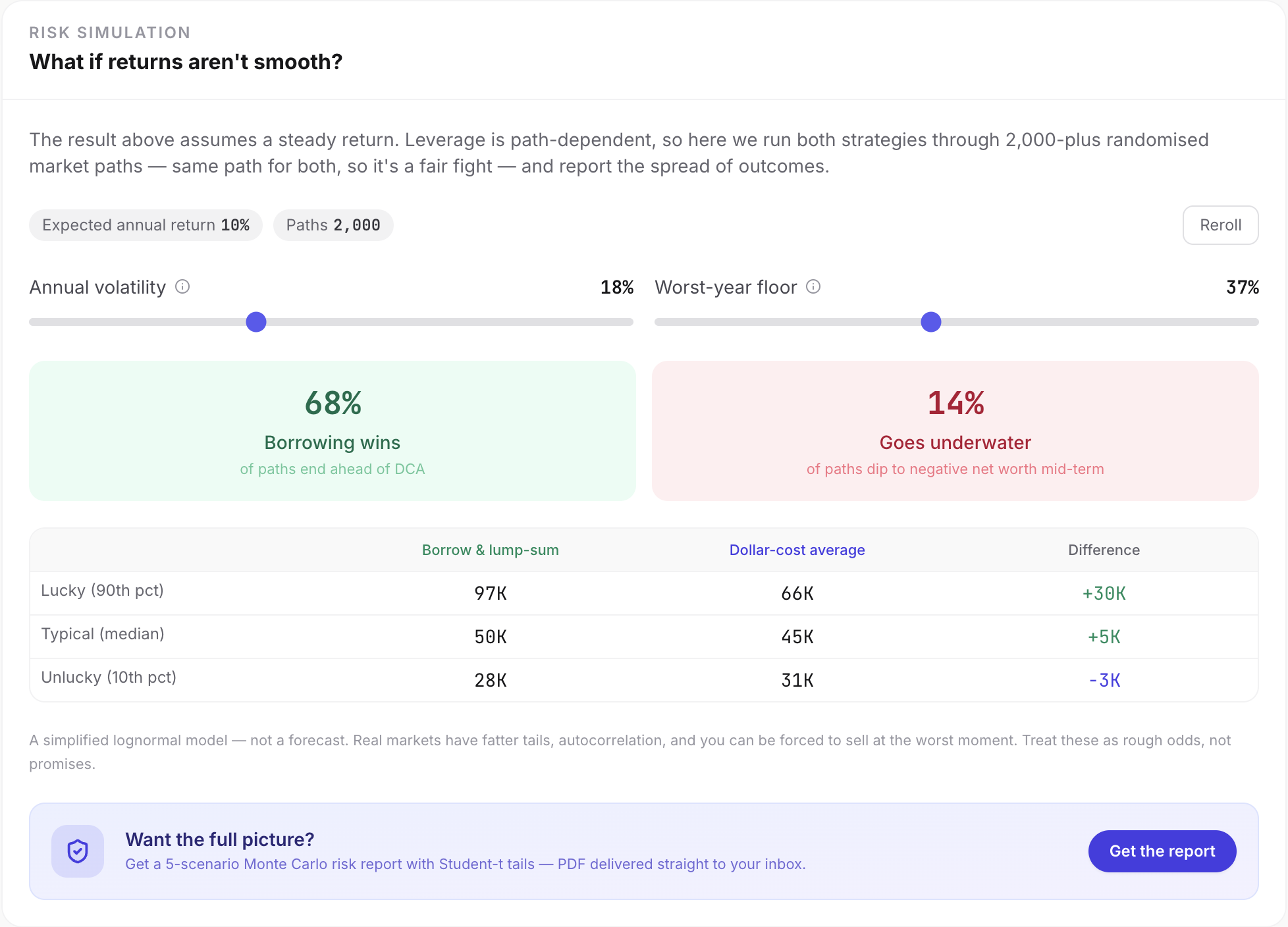 The investment is again SPY (1996–2025, with an annualized volatility of roughly 16%–18% over the past 30 years)
Assuming a 10% annual return and 15% volatility
with a maximum single-year drawdown of 37% (the financial-crisis-level decline)
running a Monte Carlo simulation 2,000 times
we find that
under these conditions, the loan-funded lump sum wins in about 73% of cases
In addition, in about 4% of the simulated scenarios
the asset's market value at some point fell below the remaining loan balance
meaning there may be a stretch where selling all your stock still isn't enough to repay the debt
If you can't stomach the volatility and cut your losses at that moment
you may miss out on the rich rewards that come afterward
And even if you're lucky enough to avoid that situation
once your cash flow can't cover the repayment on time
you may be forced to sell stock anyway
These risks all have to be taken into account
But look closely
sequence-of-returns risk might cost you some upside
yet as long as you can firmly hold for the long term
the gap in returns isn't actually that large
Over the long run, as long as the investment return keeps exceeding the borrowing cost
the loan-funded lump sum still has the higher expected value
So is borrowing to invest right for you or not?
An investing mentor I really admire (Brother Daren) once said something
if you're just asking this simple yes/no question
it means you're not ready yet
the answer is NOOOOOO
I've broken it down into a few questions myself
hoping to help everyone get clarity on their own situation
People who can seriously consider it
- The money you borrow is low-interest and long-term, like a home loan after a top-up refinance, or a low-rate personal loan
- You have stable and predictable income, the monthly payment is a small share of it, and a sudden loss of salary won't leave you unable to repay
- You keep an emergency fund that is separate from this investment
- You have high risk tolerance and are a firm long-term investor
People who really shouldn't touch it
- Those who throw in their emergency fund, or even living expenses, along with everything else
- Those with unstable income, or who'd hit a cash crunch the moment one payment is missed
- Those who can't sleep at the sight of a paper loss and can't resist cutting their losses at the very bottom
- Those who only read my one-sided notes without doing any other homework
My next step
If you're currently weighing the risks and opportunities of borrowing to invest
here are a few things worth thinking through before you act:
- Take stock of your own cash flow
- Examine your own risk tolerance
- Prepare a sufficient emergency fund
- Evaluate the asset you're investing in
- Think through how you'd respond in different scenarios
What truly decides success or failure
is often not how high the investment return is
but whether you can stay in the market
even through the worst-case scenario
This calculator and article are for educational reference only. They use a deterministic calculation with a single fixed return rate, and do not account for market volatility, sequence-of-returns risk, taxes, or personal circumstances. Borrowing to invest is a leveraged activity that magnifies both gains and losses; for actual decisions, please consult a qualified financial advisor and act within your means.
References and further reading
Frequently asked questions
What's the core principle of borrowing to invest?
It comes down to one idea: you expect your long-term investment return to exceed the cost of borrowing (the interest). That gap is the spread. As long as the spread is positive, you're using cheap interest to buy time for your capital — letting it compound in the market earlier. The catch is that no one can guarantee the spread holds, and that's exactly where the risk lives.
What is the break-even return rate?
It's the annualized investment return at which a loan-funded lump sum and dollar-cost averaging end up with the same final assets — roughly a touch above your loan rate. For a $30,000 personal loan at 3.5% over 5 years, the break-even return lands around 3.6%. As long as your long-run return stays comfortably above that line, the loan-funded lump sum has the higher expected value.
Does a loan-funded lump sum always beat dollar-cost averaging?
No. The biggest variable is sequence-of-returns risk — borrowed money is fully invested on day one, so a crash in the first year or two hits the largest principal immediately, while DCA keeps buying cheaper shares during the dip. In a Monte Carlo simulation (10% return, 18% volatility, 37% worst-year drawdown, 2,000 runs), the loan-funded lump sum wins about 73% of the time — but in roughly 14% of scenarios the portfolio value dropped below the remaining loan balance at some point, i.e. underwater.
Who should and shouldn't borrow to invest?
Better suited: those borrowing at a low rate over a long term (e.g. a home-equity top-up), with stable, predictable income where the monthly payment is a small share of it, a separate emergency fund untouched by the investment, and the discipline to hold for the long run. Should avoid: anyone pouring in their emergency fund or living expenses, with unstable income, who can't sleep through paper losses and would panic-sell at the bottom, or who acts on a single article without doing their own homework.

About the Author
indigo.la.ringo
A software engineer chasing the slash-career dream. Was trying to figure out my relationship with the world — now being forced to figure out my relationship with AI. Lately, obsessed with figuring out the relationship between people and money. Either way, whatever answer I land on, it's fine.
Feedback
Thoughts or suggestions after reading? I'd love to hear them.