Should Young People Lever Up Early? A Look at Lifecycle Investing
I recently finished Lifecycle Investing
written by two professors from Yale
Building on the investment ideas of Nobel laureate Paul Samuelson
they propose a practical investing method
that, holding risk constant
can lift your returns by more than 50%
How exactly does a free lunch like that work?
Come take a look with me
What lifecycle investing actually says
Lifecycle Investing
is the work of professors Ian Ayres and Barry Nalebuff
My own translation of the whole book boils down to one sentence
Diversify your risk across time
Here's an example
We all know about sequence-of-returns risk
If we run into a black swan right at retirement
we may have to cut our withdrawal amount
and our quality of life in retirement takes a big hit
But if we had enough capital
couldn't we ride out that temporary crash-driven dip?
If we believe the stock market goes up in the long run
doesn't that mean every pullback is temporary?
Thinking about it that way
the solution is simple
just wait a few more years
So how do we buy ourselves those extra years?
We can move future money into the market earlier
so every dollar spends more time running in the market
Time diversification: spreading risk across a lifetime
We all know not to put our eggs in one basket
so we might buy an ETF
or even invest in the whole world
But the traditional approach can't diversify risk across time
The whole point of lifecycle investing is to raise your exposure when young
and lower it as you age
It's like taking some of your old-age capital and investing it earlier
Even if it takes a hit
because it entered the market earlier
it also gets to recover earlier
In practice it looks something like this
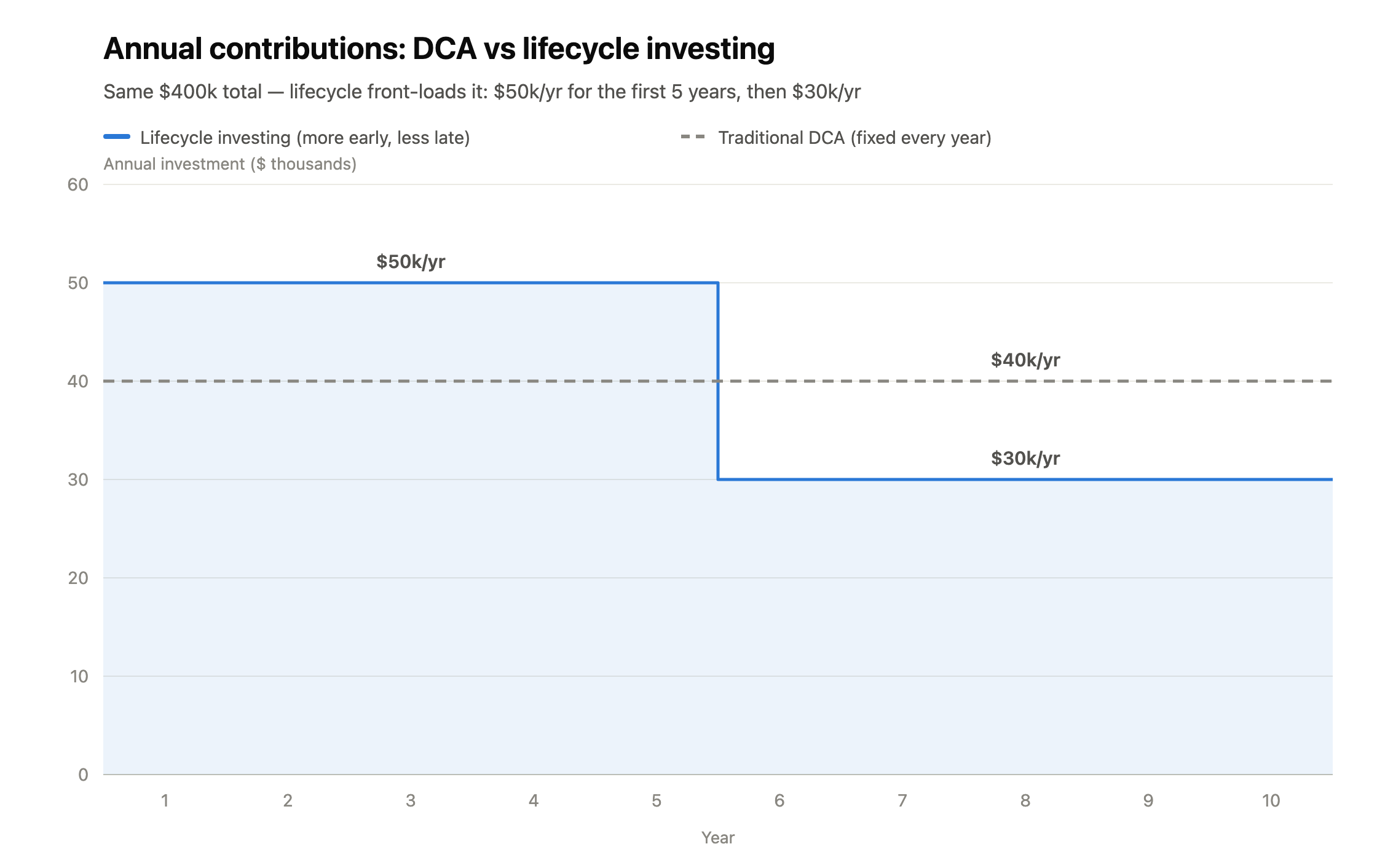
Say the total amount we'll put into stocks is $400,000
invested over ten years
Traditional DCA might be $40,000 per year
Lifecycle investing would instead suggest
front-loading more — say $50,000 a year early on
and dropping to $30,000 a year when we're older
The total invested is exactly the same
but the money gets into the market sooner
more of your capital enjoys the market's growth
and it has more time to recover from downturns
I made a quick diagram:
The authors suggest going up to 2x leverage when young
that is, letting twice the capital participate in the market
then gradually stepping down to 1x in between
I'll spare you the details here
With this approach
in their historical backtests
at the same level of risk
the median outcome improved by a remarkable 50%
In practice, how do you get more than 1x exposure?
Simply put
you borrow to move future income into the market earlier
There are just different ways of borrowing to get invested
such as:
- Leveraged ETFs
- Loans
- Futures
- Options
- Margin trading
Let's go through these methods and the practical details one by one
Loans
The simplest way is a personal loan or a mortgage top-up
to borrow extra money and put it into the market
But the interest rate varies from person to person
so if your rate is too high
the math may not actually work out
You can start with this Loan-to-Invest Calculator
to see whether the loan is worth the risk
Buying on margin
In the Taiwanese stock market
you can buy stocks through a margin account
The current rule puts the initial margin at roughly 40%
meaning you can buy $100,000 of stock with $40,000 down
which also means you've opened 2.5x leverage on that position
Put up $50,000 instead
and you're back to 2x
But brokers aren't charities
margin interest rates are actually quite high (around 4–6%)
And Taiwan has a maintenance ratio requirement (currently 130%)
Say you buy $100,000 of stock with $50,000 down
when your stock's market value falls to $65,000
your maintenance ratio sits exactly at 130%
At that point the broker demands more cash to restore the ratio
or you get forcibly liquidated — a margin call
Futures
Futures work a lot like a margin system
You put down a deposit as collateral
but when your position's value drops close to overtaking your margin
the futures broker demands more collateral or force-closes you
That's why so many people open oversized leverage and lose everything
The other risk with futures is that you must roll before expiry
that is, roll this month's contract into next month's (unless you want to exit the market)
which means slippage and rollover risk and cost to account for
Options
An option, simply put, is buying the right to buy or sell an underlying asset
but this is far too advanced for a beginner like me
Even though the book itself recommends this approach
the Taiwanese and US markets are quite different
so I haven't dug any deeper into this part myself
Leveraged ETFs
A leveraged ETF is a fund that uses derivatives (futures, swap contracts)
to track an index and amplify its daily return by a multiple (usually 2x or 3x)
Simply put, you pay a fund manager to handle the derivatives
and they work to deliver:
the index rises 5%, I rise 10%
and vice versa
The upside is you don't have to manage anything yourself (you've outsourced it)
But besides the higher expense ratio leveraged ETFs charge
there's also volatility decay
You can use this Leveraged ETF Calculator
to get a feel for what volatility gives and takes
So which one is best?
Everyone gets different financing terms
and wants to invest in different things
That's why I built this 2x ETF vs Loan vs Margin tool
so you can see which set of terms suits you best
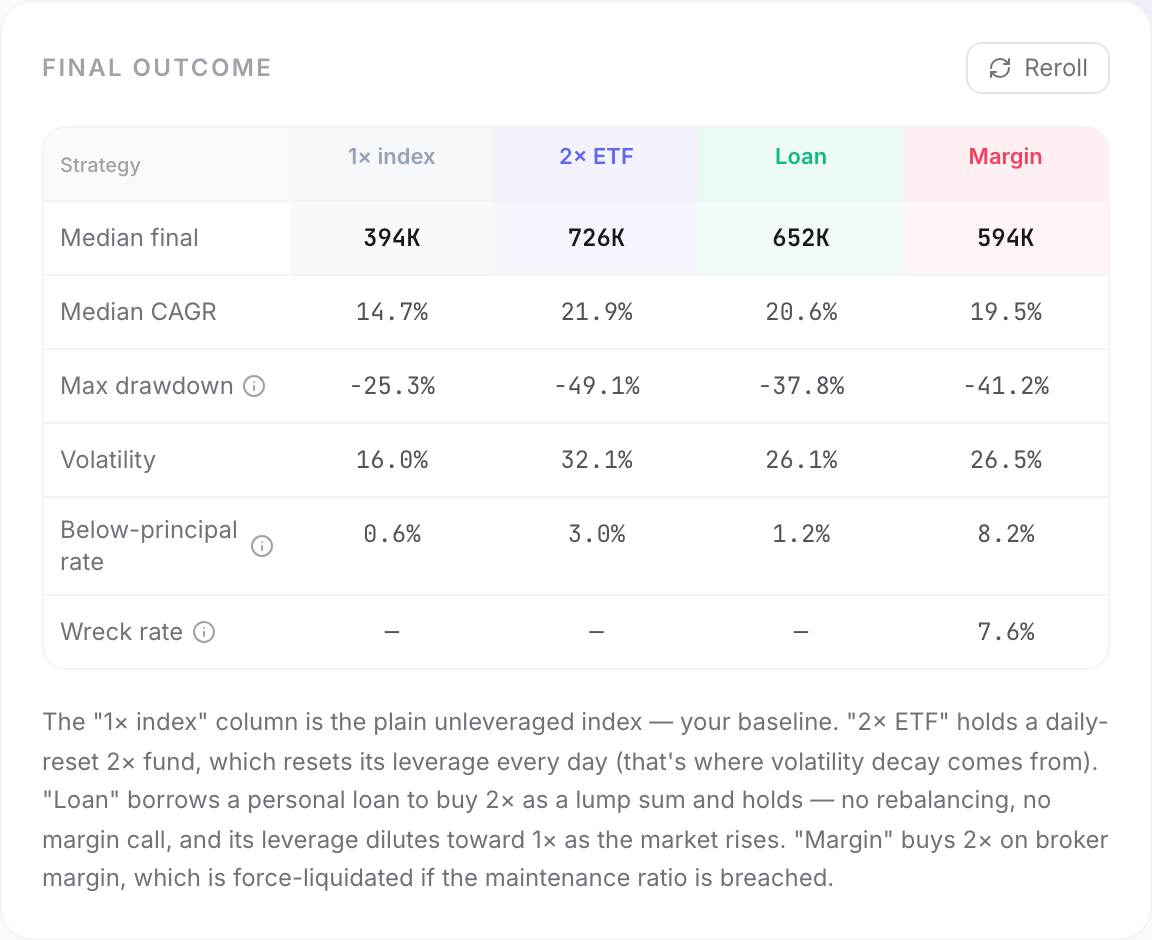
Plug in your own assumptions
gauge your own risk tolerance
and see whether the lifecycle-investing strategy is right for you
Comparing the methods
I believe everything that exists has its reason
Even if some strategy has a spectacular return
whether you can actually hold on to it is another question
There's no single best answer
only the one that fits you
Here's my rough summary of pros and cons:
- Loan: the interest rate is gravity — you need solid proof of income or assets to negotiate a low rate
- 2x ETF: set-and-forget, but you pay the expense ratio; the rallies feel great, but you must stomach volatility decay in sideways markets and a halved account in drawdowns
- Margin: when the maintenance ratio gets low you must be able to inject cash, and the rate is usually on the high side
- Futures/Options: advanced derivatives — I have limited experience with them myself
Closing thoughts
People have always said "never borrow to invest"
but I think that mindset is starting to shift
Think about it — real estate is one giant leveraged loan investment
You may only need a 20% down payment to buy
which means you've opened 5x leverage from day one
yet nobody criticizes homebuyers for it
What lifecycle investing left me with most is this:
"Time" is a young person's greatest asset.
That's also why I believe long-term investing
is how ordinary people climb the ladder
May we all make it to the next stage
This calculator and this article are for educational purposes only and are not investment advice. Lifecycle investing is a long-term framework that demands discipline and preconditions; leverage magnifies both gains and losses, and real margin trading has intraday maintenance calls that can liquidate you faster and deeper than any model. Consult a qualified financial advisor and never invest more than you can afford.
References and further reading
- Ayres & Nalebuff — Lifecycle Investing (official site)
- Lifecycle Investing — Traditional Chinese edition ebook (Kobo)
- SEC — Investor alert on leveraged and inverse ETFs
- Investopedia — Leverage: definition and risks
- The Shell Seeker — Lifecycle Investing book notes (Medium, Traditional Chinese)
- AppicLab — Borrowing to Invest: Reckless Gamble or Rational Choice?
- AppicLab — Lump Sum or Dollar-Cost Averaging? Use the Risk Report to See Your Real Odds
- AppicLab — FIRE Calculator Guide: How to Calculate Financial Independence and Retire Early
Frequently asked questions
What is lifecycle investing?
It was proposed by Yale professors Ian Ayres and Barry Nalebuff in their book Lifecycle Investing. The core idea: your investment exposure shouldn't be based only on 'how much money you have right now,' but on 'the total amount you'll invest in the market over a lifetime.' When you're young your capital is small — even 100% in stocks is a tiny share of your lifetime wealth, which means your risk is over-concentrated in the second half of your life. They argue that moderate leverage when young (capped around 2x) pulls your equity exposure forward and spreads it evenly across more years, reducing the time-concentration risk of 'all your chips riding on just a few years.'
Why does lifecycle investing cap leverage at 2x rather than higher?
The authors explicitly set the leverage ceiling at 2:1, and dial it down gradually as you age and your assets grow. The reason: leverage magnifies long-term expected returns, but it also magnifies drawdowns and the risk of ruin. Beyond 2x, a single deep crash can wash you out of the market entirely — destroying the very premise of 'staying invested for the long run.' Two-to-one is the compromise between 'spreading time risk' and 'still surviving a crash.'
For 2x exposure, should I pick a 2x ETF, a loan, or margin?
All three give you roughly 2x the index's daily moves, but the mechanics are worlds apart. A 2x ETF resets its leverage back to 2x every day — the leverage is locked in, but you pay an expense ratio and volatility decay erodes you in choppy markets. A personal loan is a one-time borrow-and-hold: it dodges the daily decay and can never be margin-called, but the leverage dilutes toward 1x as the market rises, and you must keep repaying the debt throughout. Broker margin is the cheapest, but your shares are the collateral — fall below the maintenance threshold (commonly 130% in Taiwan) and you get force-liquidated.
Why does margin get liquidated in a crash while a loan can ride it out?
Because a personal loan has no claim on your position — the lender only cares that you make your monthly payments, not what the stock price does. When the index drops 35%, a 2x margin position falls below the 130% maintenance ratio and the broker sells you out at the bottom, locking in the loss and making you miss the rebound. With the same drop, a loan-funded holder is underwater on paper but still holding — when the market comes back, so do they. That ability to 'hold on' is exactly what lifecycle investing depends on.
Is lifecycle investing for everyone?
No. It has strict prerequisites: you need stable, predictable future income (your salary is your 'bond-like' allocation), the stomach to watch your account get cut in half without selling at the bottom, and you must do it entirely with money your life doesn't depend on. If your income is unstable, your emergency fund is thin, or paper losses keep you up at night, leverage will only sweep you out of the market faster. It's a long-term framework that demands discipline — not a shortcut to getting rich.

About the Author
indigo.la.ringo
A software engineer chasing the slash-career dream. Was trying to figure out my relationship with the world — now being forced to figure out my relationship with AI. Lately, obsessed with figuring out the relationship between people and money. Either way, whatever answer I land on, it's fine.
Feedback
Thoughts or suggestions after reading? I'd love to hear them.